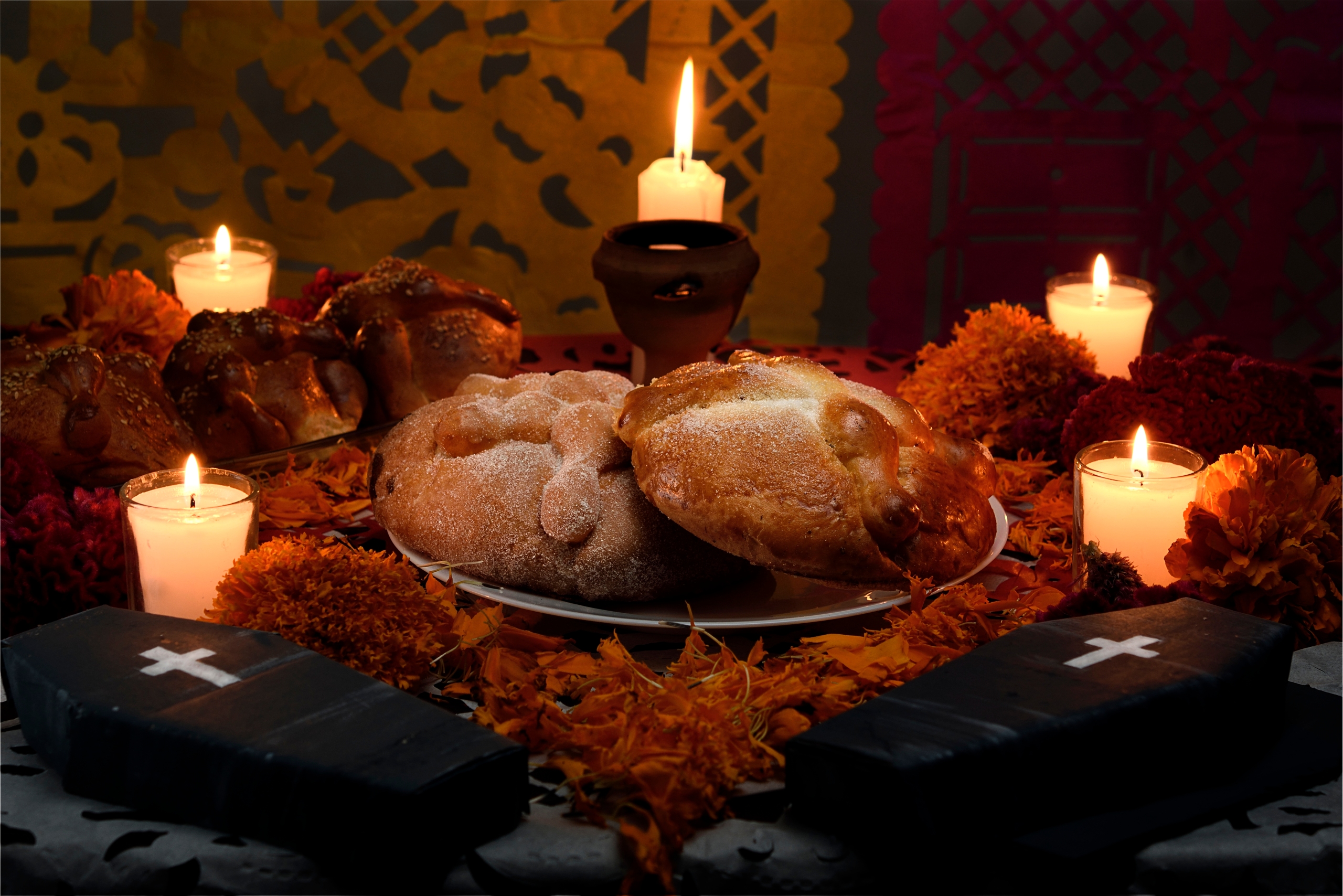
The scent of freshly baked bread, the smoke of copal incense, and the marigold petals marking a luminous path: this is how November begins in Mexico, when everyday life mingles with memory. At the heart of the Day of the Dead—one of the country’s most enduring cultural observances—there is an offering that never fails to appear on altars: pan de muerto, the Bread of the Dead. Soft and sweet, adorned with shapes that evoke bones and skulls, it is not merely eaten or shared. It is offered. It is remembered. It is honored.
Though often described as pre-Hispanic in origin, pan de muerto did not exist in the Americas before the arrival of the Spanish. Its basic ingredients—wheat, sugar, butter, and eggs—were introduced by European colonizers, along with the Christian custom of blessing and offering special breads for the departed. When these practices encountered Indigenous ideas about death and the return of souls, something distinct emerged: a hybrid ritual that reimagined remembrance through the senses.
The soul breads of Europe
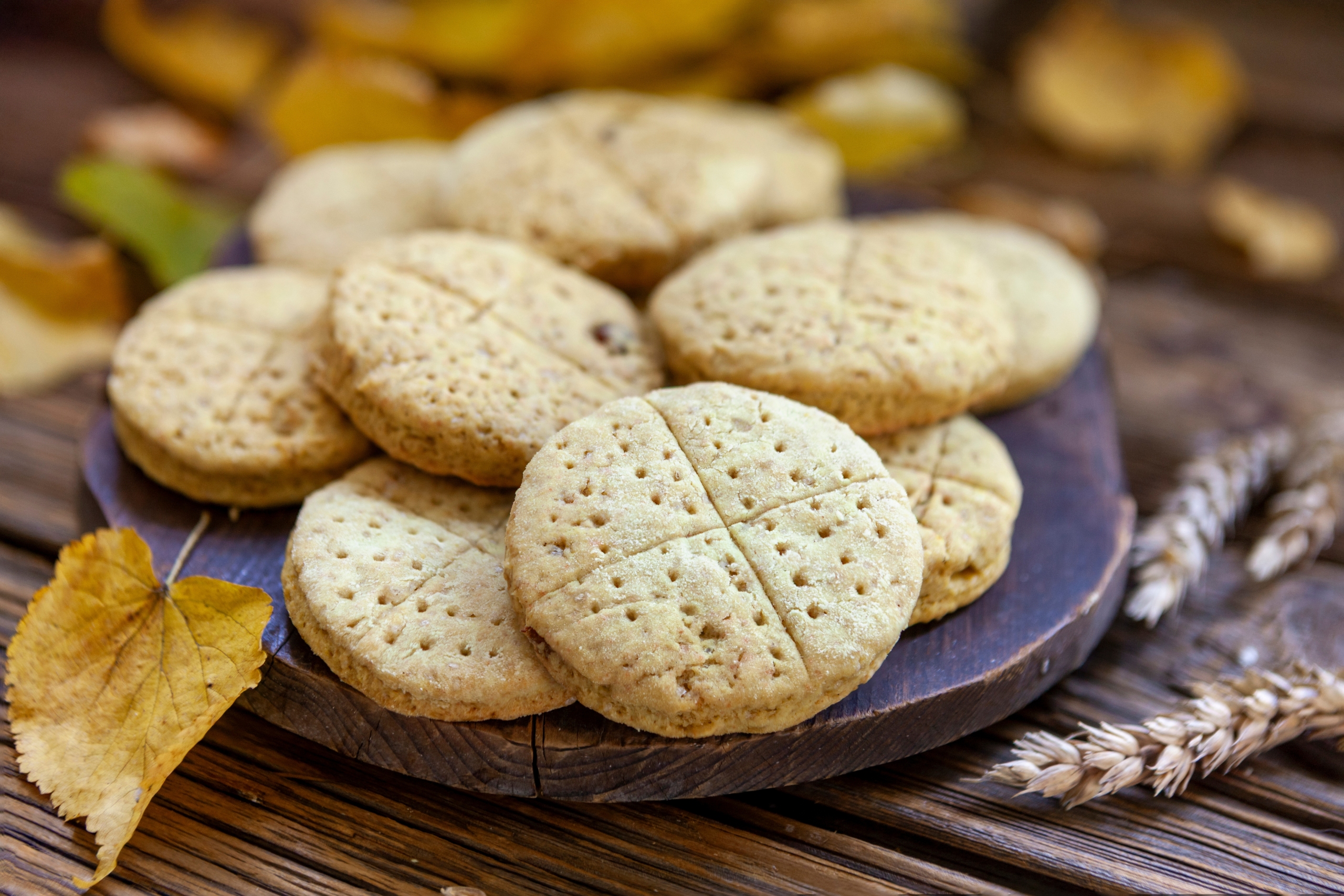
Long before its journey across the Atlantic, the practice of baking bread for the dead existed in various parts of Christian Europe. In Spain, panes de ánimas—soul breads or votive loaves—were prepared for All Souls’ Day. Families brought them to churches to be blessed, then left them on graves or distributed them among the poor as acts of charity. In some regions, the bread was left directly in cemeteries as sustenance for the souls in purgatory. In England the tradition of baking soul cakes still exists
These loaves represented more than nourishment. They embodied remembrance and continuity, serving as edible symbols of care for the dead. Sharing them expressed the belief in a community extending beyond life itself. When this European ritual arrived in the Americas, it found fertile ground in local cosmologies that understood death not as an end, but as part of a cyclical return.
From blessed bread to Mestizo bread
In the sixteenth century, Spanish settlers in the Viceroyalty of New Spain introduced both their faith and their culinary repertoire—wheat, dairy, sugar, and eggs—into Indigenous societies that already possessed complex funerary traditions. The encounter did not erase those traditions; it transformed them.
Indigenous peoples reinterpreted the soul bread according to their worldview, in which the dead remained active participants in life’s cycle. From this encounter emerged a new creation: pan de muerto. Its essence was not purely European nor entirely Indigenous, but a cultural synthesis—European ingredients given new symbolic purpose within American ritual life.
Symbolic aesthetics of the traditional loaf
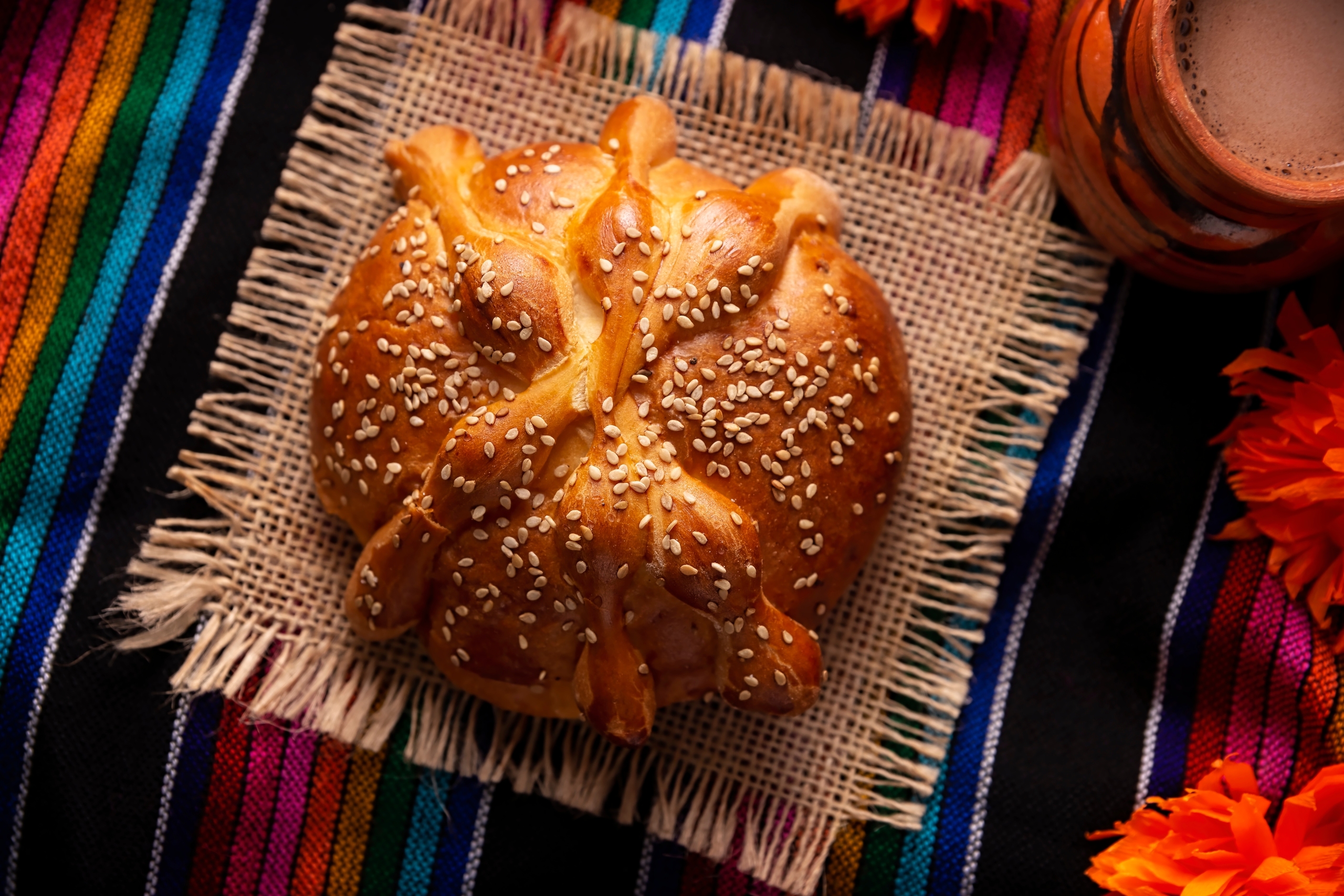
The most familiar pan de muerto is round, decorated with strips of dough that resemble bones arranged in a cross and crowned with a central sphere symbolizing the skull. The circular form alludes to the cycle of life and death; the bone motifs recall the physical remains of ancestors. Some interpretations link the four “bones” to the cardinal directions, echoing pre-Columbian spatial cosmologies in which deities guarded each quarter of the universe.
Traditionally dusted with white or pink sugar and scented with orange blossom water, the bread evokes both festivity and spirituality. Its fragrance, associated with the soul in Mexican popular symbolism, connects the act of eating to remembrance itself—a sensorial gesture toward the dead.
Festive anthropophagy
Eating pan de muerto carries a symbolic dimension as well. Biting into bread that represents the deceased has been described by scholars as a form of “ritual anthropophagy”—a symbolic incorporation of the loved one. Cultural historian José Luis Curiel once noted that for Mexicans, “to eat one’s dead is a pleasure.” The act is not macabre but intimate, expressing a relationship with death marked by familiarity, tenderness, and even humor. Through the bread, absence becomes presence.
When Europe forgot and Mexico remembered
In its early colonial form, pan de muerto was a modest preparation—simple wheat bread, barely sweet, baked in a nascent artisanal context. Over time, it evolved. Butter, eggs, refined sugar, anise, and orange essence enriched its texture and aroma. By the twentieth century, it had become a national tradition, filling markets and bakeries across the country in late October and early November.
Meanwhile, the custom of baking soul breads in Europe faded with secularization and modernization. In Mexico, however, the tradition not only endured but flourished. No other country preserves a comparable ritual bread so widely recognized or emotionally resonant. The pan de muerto became both a culinary and cultural emblem, woven into the collective calendar of remembrance.
A thousand breads, one memory
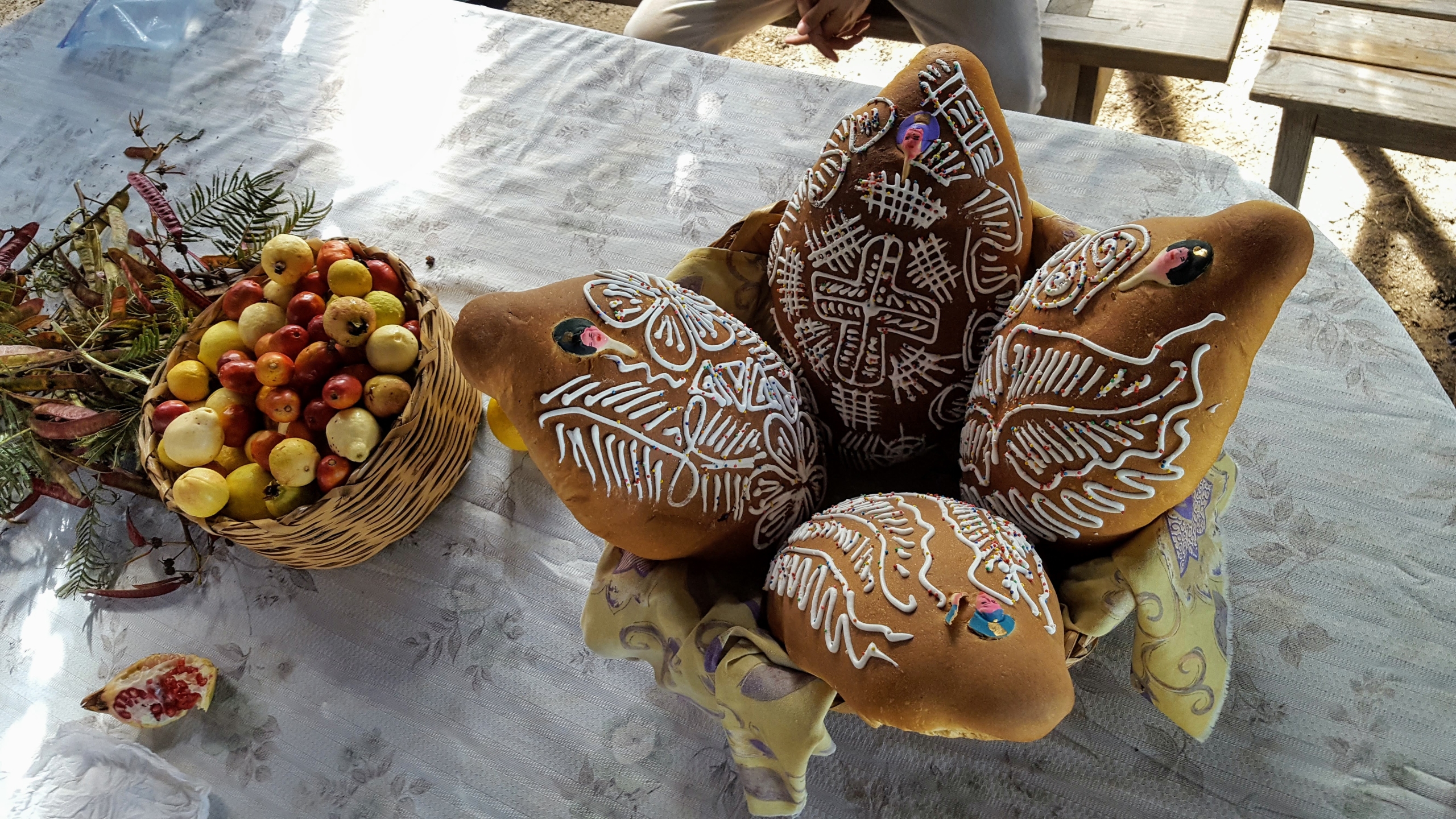
Across Mexico, regional variations illustrate the diversity of this living tradition. In the Valley of Mexico, the classic round loaf with “bones” and sugar topping remains the most common. In Oaxaca, pan de yema—rich in egg yolks and often decorated with sesame or sugar figures—takes pride of place. Among the Purépecha communities of Michoacán, bakers produce glossy loaves inscribed with names or dedications, known as panes de hule.
In the Huasteca region, pelucas are anthropomorphic breads representing the dead, dusted with red sugar. In Guerrero, bakers create brightly colored loaves in the shapes of animals or human figures, known locally as camarones or almas. These forms embody the creativity and regional identity of each community, demonstrating how the tradition adapts while retaining its symbolic core.
Between tradition and modernity
In contemporary Mexico, pan de muerto occupies a space that bridges ritual, commerce, and innovation. It appears on home altars and in artisanal bakeries, cafés, supermarkets, and digital platforms. Modern versions are filled with chocolate, caramel, or cream; some are flavored with coffee or vanilla, or reinterpreted as ice creams and pastries inspired by its taste.
Such reinvention reflects the tradition’s vitality rather than its decline. Many bakers emphasize the importance of balance—innovating without erasing the bread’s meaning. Despite the abundance of new forms, each year millions of families still seek the familiar version: the one that smells of childhood, of family altars, of marigolds and memory.
Shared bread, living memory
Pan de muerto embodies, in tangible form, the story of cultural synthesis in Mexico. Born from the meeting of European votive breads and Indigenous offerings, it has become a symbol of remembrance expressed through food, color, and communal gathering.
Each November, as people share this bread among the living and the absent, they renew a bond that crosses generations. In Mexico, memory is not only preserved—it is tasted.
AI Transparency Notice
PilgriMaps uses artificial intelligence tools to assist in the research, drafting and translation of editorial content. All AI-assisted content is reviewed, edited and verified by our editorial team before publication. We contrast information against primary sources, specialist literature and on-the-ground knowledge to ensure accuracy, cultural sensitivity and editorial integrity.
AI is one tool among many in our workflow. The judgement, curation and responsibility for everything published on this platform remain entirely human.
Viator Media S.L. — in compliance with the EU Artificial Intelligence Act (Regulation EU 2024/1689).
This post is also available in: