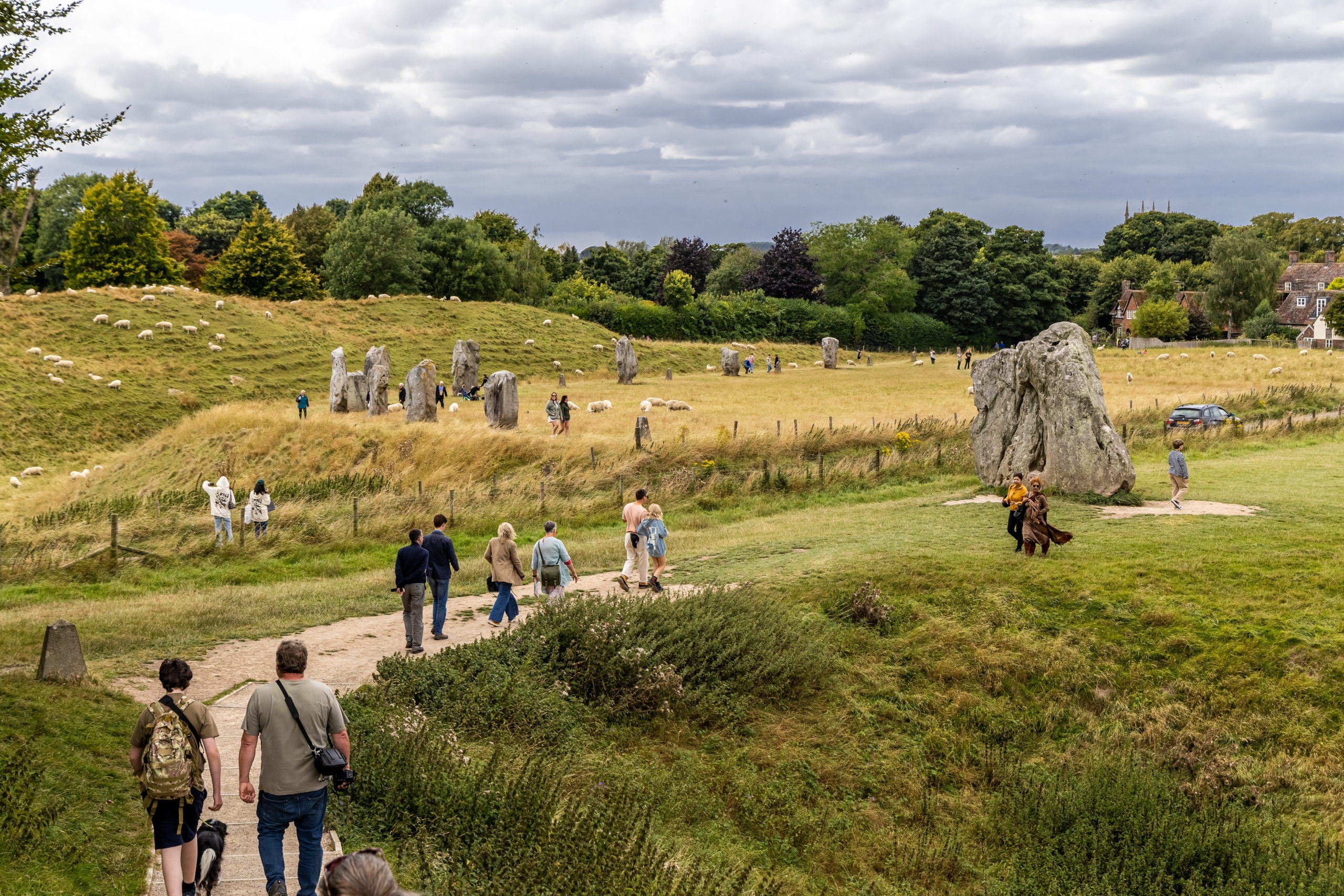
In Wiltshire, a great ring of stones encircles a quiet English village. Unlike the solitary grandeur of Stonehenge, its more famous neighbor, Avebury is expansive, immersive, and intimately tied to its surrounding landscape. Built and modified over a period spanning from roughly 3000 to 1600 BCE, Avebury is among the largest prehistoric stone circles in Europe. Its scale and complexity, however, are not simply feats of engineering—they are expressions of a Neolithic worldview in which stone, soil, and movement formed a ritual landscape, orchestrating relations between the living, the dead, and the celestial sphere.
Avebury was never just a monument; it was a destination, a ceremonial node within a broader sacred geography that shaped and was shaped by patterns of prehistoric movement. In this sense, it may be understood as a site of prehistoric pilgrimage, not to a shrine or deity, but to a place of alignment and transformation.
The Architecture of Alignment
Avebury’s construction spans millennia. The main henge—a massive circular bank and ditch nearly 400 meters in diameter—encloses a ring of standing stones, many of which still stand today despite centuries of destruction and repurposing. Within this outer circle once stood two smaller inner circles, likely used for specific ritual purposes.
To approach Avebury is to engage with its monumentality through motion. Unlike Stonehenge, which isolates the viewer outside its circle, Avebury was designed to be entered. Its stones invite movement between, around, and through them. This choreography of passage seems central to its meaning—pilgrimage here meant not just arrival, but procession.
Leading into the site is the West Kennet Avenue, a serpentine double row of stones stretching over two kilometers to the site known as The Sanctuary, itself another ceremonial complex. Together, these features form a ritual corridor, designed not for defense or habitation, but for orchestrated passage. They suggest a people who walked, again and again, across a landscape designed to structure sacred movement.
Prehistoric Cosmology and the Power of Place
Avebury was not an isolated construction. It existed within a dense concentration of prehistoric sites—burial mounds, long barrows, standing stones, and causeways—each participating in a shared cosmological logic. Nearby lies Silbury Hill, the largest prehistoric mound in Europe, and West Kennet Long Barrow, an earlier Neolithic tomb reused for centuries. Together, these monuments articulate a landscape invested in continuity between life, death, ancestry, and the sky.
While there is no direct evidence of a pantheon, the orientation of many features at Avebury and its neighboring sites strongly suggests solar and lunar alignments. These orientations may have helped communities track seasonal change, a vital concern in agrarian societies. Yet the precision of these alignments and their integration into monumental forms point to something more than utility. They represent worldviews encoded in earth and stone, where cosmological order was both celebrated through ritual.
Pilgrimage Without Doctrine
The concept of pilgrimage in prehistoric Britain must be approached without assumptions inherited from later religious traditions. There were no written texts, no centralized temples, and no priestly class in the modern sense. But what Avebury shows – like Göbekli Tepe in Anatolia or the Talaiotic complexes of the Balearics – is that ritual movement across the land predates institutional religion.
Archaeological evidence suggests that people traveled considerable distances to participate in gatherings at Avebury and its surrounding monuments. Animal remains from distant regions, specialized pottery, and traces of feasting all point to episodic congregation – events that drew dispersed communities together. These were likely times of social renewal, alliance-building, and ceremonial performance, punctuated by shared journeying.
To travel to Avebury in 2500 BCE may have been to traverse even cosmic orientation – to participate in a cyclical pattern of movement tied to solstices, harvests, or rites of passage. The stone avenues and sightlines shaped that experience, marking the land itself as sacred text.
Before the Churches: Ħal Saflieni and Malta’s Prehistoric Sacred Traditions
Persistence and Transformation
Unlike many ancient ritual sites, Avebury was never fully buried or forgotten. Medieval and early modern villagers dismantled parts of the circle, repurposing stones for buildings and burying others in superstitious fear. In the 20th century, restoration efforts led by archaeologist Alexander Keiller revived scholarly and popular interest, reframing the site as a key to understanding Neolithic Britain.
Today, Avebury draws a wide range of visitors – archaeologists, tourists, spiritual seekers. Though its original meanings remain partially obscured, its atmosphere of significance endures. The path along the West Kennet Avenue still invites walking. The silence between the stones still evokes reflection. Whether one views it as ancestral monument, cosmic observatory, or prehistoric sanctuary, Avebury continues to function as a kind of pilgrimage site – a destination defined less by dogma than by landscape, memory, and movement.
AI Transparency Notice
PilgriMaps uses artificial intelligence tools to assist in the research, drafting and translation of editorial content. All AI-assisted content is reviewed, edited and verified by our editorial team before publication. We contrast information against primary sources, specialist literature and on-the-ground knowledge to ensure accuracy, cultural sensitivity and editorial integrity.
AI is one tool among many in our workflow. The judgement, curation and responsibility for everything published on this platform remain entirely human.
Viator Media S.L. — in compliance with the EU Artificial Intelligence Act (Regulation EU 2024/1689).
This post is also available in: