In 2012, global attention turned toward a civilization that had flourished more than a millennium earlier. Commentators wondered whether the ancient Maya had anticipated an imminent collapse of the cosmos. Some people stocked supplies; others speculated about unseen planets headed toward Earth. Popular films amplified the idea with collapsing landscapes and impossible fissures. For a brief period, the Maya calendar was framed as a cosmic timer approaching zero.
The narrative was striking, but it lacked any foundation in Maya thought. The Maya did not expect a definitive end of the world—unlike certain interpretations among the Mexica (Aztecs)—nor did their calendar function as an apocalyptic prophecy. What they developed instead was an exceptionally sophisticated system for understanding time: an interwoven set of cycles that connected astronomy, mathematics, community life, and ceremonial practice. Within this system, celestial order converged with agricultural rhythms, the birth of a child, the beginning of a journey, or the accession of a ruler.
This article revisits the modern myth to explore what the Maya calendar represents: a dynamic, cyclical conception of time embedded in daily experience.
How Modern Interpretations Turned It into a Global Phenomenon
Contemporary fascination with the Maya calendar owes more to recent interpretations than to Maya tradition. The usual point of departure is the 1960s, when archaeologist Michael D. Coe mentioned—almost in passing—that the completion of the thirteenth baktun might have carried transformative significance. Intended as a speculative remark, it later became the seed for esoteric readings.
During the 1980s and 1990s, writers such as José Argüelles, known for The Maya Factor (1987), and Terence McKenna, creator of the eccentric “Timewave Zero,” reframed the calendar through spiritual and futurist lenses. John Major Jenkins added the idea of a supposed “galactic alignment” in 2012—a claim that lacked scientific basis yet proved compelling enough to become a publishing success.
Theories involving planetary disruptions, magnetic shifts, or cosmic alignments circulated widely, inspiring documentaries, bestsellers, and films. As the calendar entered popular culture, archaeologists repeatedly offered a simple conclusion: no Maya inscription announces a global end. The conclusion of a baktun marks a ritual transition—a renewal rather than a destruction. Maya communities celebrated the movement of time; they did not fear it.
A System of Interlocking Cycles
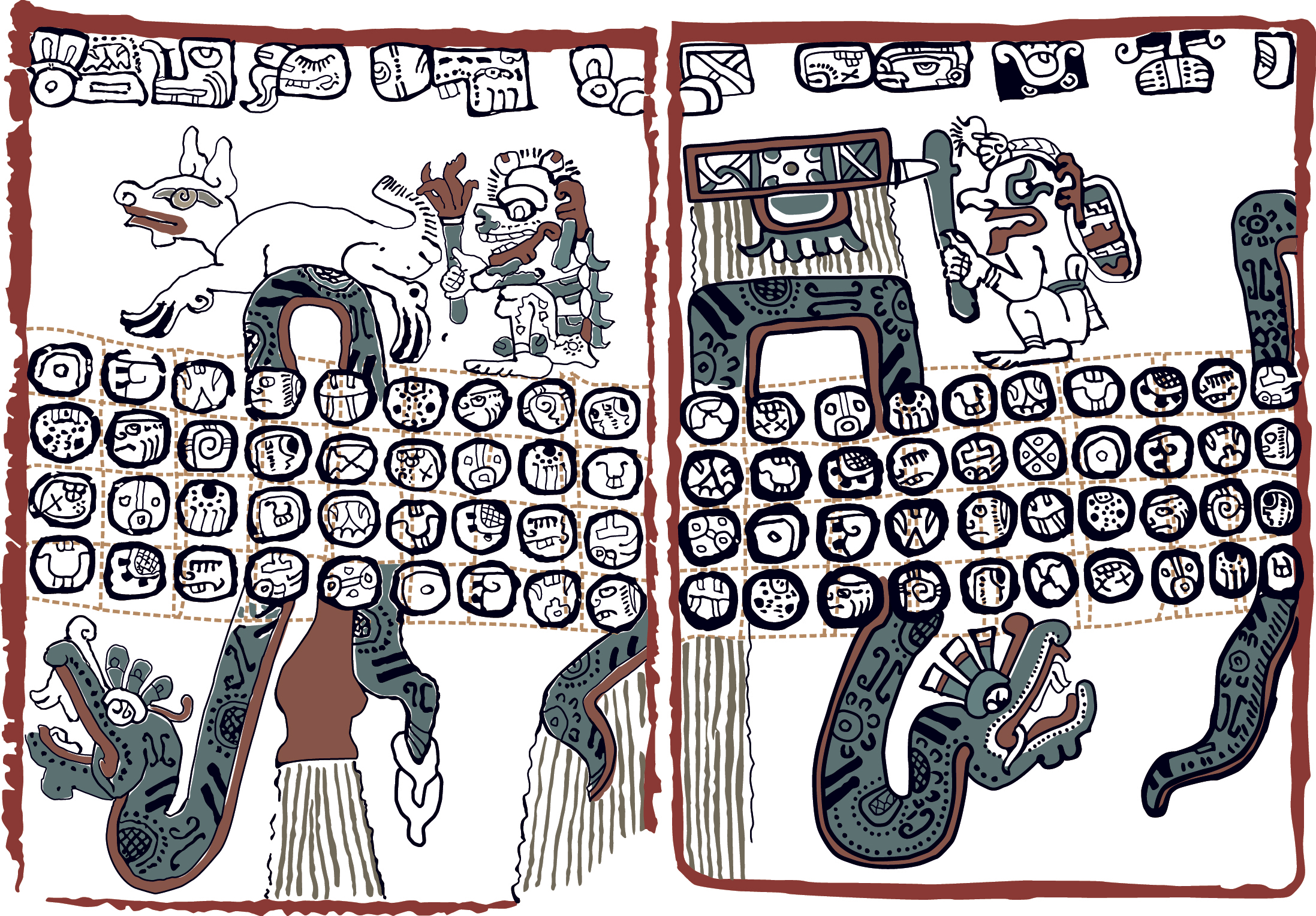
Understanding this outlook requires stepping away from the familiar idea of a calendar as a list of dates. The Maya used several cycles that interacted with one another. The Tzolk’in, with 260 days, governed spiritual and communal rhythms. The Haab’, with 365 days, structured agricultural and civic life. Together, these cycles created a 52-year “Calendar Round,” a period that repeated roughly once per generation. To record historical and mythic events, the Maya used the Long Count, which could encompass thousands of years.
This intricate system reflects a culture that observed the skies with remarkable precision. Maya astronomers tracked Venus cycles, calculated eclipses, and incorporated the concept of zero centuries before it appeared in many other parts of the world. Their calendar was not merely practical; it offered a framework for understanding a structured and meaningful universe.
The Tzolk’in: A Cyclical Pulse of Time
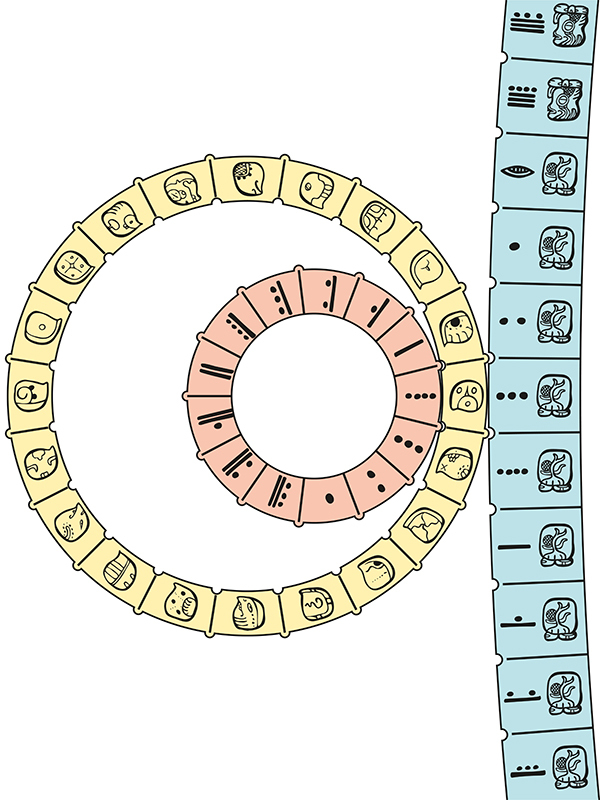
The 260-day Tzolk’in was closely connected to communal and ceremonial life. Each day combined a number and a name, creating a sequence rich in symbolic associations. Rather than following seasons, it articulated a pattern of shifting energies—days suitable for planting, healing, travel, or collective action.
Specialists trained in interpreting these cycles advised their communities, selected ceremonial dates, and guided naming practices for newborns. This tradition remains active today. K’iche’, Kaqchikel, Tz’utujil, Q’eqchi’, and Mam communities in Guatemala—as well as Tzotzil and Tzeltal communities in Chiapas—continue to consult the Tzolk’in to structure observances and recognize ajq’ijab’, or daykeepers. In these regions, the Tzolk’in endures not as an archaeological relic but as a living framework.
The Haab’: The Agricultural and Civic Cycle
While the Tzolk’in shaped ceremonial life, the 365-day Haab’ organized daily activities. Its structure—eighteen months of twenty days plus the five transition days of the Wayeb’—aligned with agricultural work, tribute cycles, and communal gatherings. Observers followed the cycles of maize, rainfall, hunting, and soil fertility, integrating them into monthly observances.
The Wayeb’ formed a liminal interval. Communities paused work, postponed travel, and performed protective rites. When the interval ended, the new solar year began with fire ceremonies, purification practices, and the reorganization of civic responsibilities. The Haab’ therefore set the rhythm of community life and delineated its annual cycle.
The Long Count: Time Measured on a Monumental Scale
The Long Count is the most widely known component of the system, although often misunderstood. It did not function as a countdown to catastrophe. Instead, it placed historical events within an expansive temporal horizon. Its starting point—corresponding to 3114 BCE—represents a mythic creation date. From this origin, days accumulate through larger units until reaching the baktun, which spans nearly four centuries.
The cycle that concluded in 2012 marked the end of the thirteenth baktun. Because the number thirteen carried symbolic importance, the transition had meaning. Yet nothing indicates that the Maya connected it with collapse. Some inscriptions even reference dates far in the future, including celebrations projected for 4772 CE in texts from Palenque. For the Maya, the Long Count did not close the world; it introduced another chapter.
Time, Place, and Movement
For the Maya, time was not an abstract metric. It was animated, and it expressed itself in specific landscapes. Temples, caves, cenotes, and solar-aligned structures played roles within the ceremonial calendar. Celestial events indicated when to undertake pilgrimages, make offerings, or open and close ritual spaces.
Pilgrimages followed precise dates because time and place formed an integrated system. At Chichén Itzá, for instance, the equinox light effect on the pyramid of Kukulcan—a descending pattern often called the “serpent of light”—functioned as a visual affirmation of cosmic order. The calendar acted as both a map for travelers and a measure of the universe’s cycles.
A Matter of Legacy
Beyond the media narratives of 2012, the Maya calendar stands out as an intellectual achievement of extraordinary depth. It unites astronomical knowledge, social organization, ceremonial life, and direct experience of the natural world. It did not predict the end of time; it articulated meaningful ways to inhabit it.
Rather than a device for measuring days, it shaped a dialogue between people and the cosmos. Its central lesson lies in renewal: each completed cycle opens the way for the next. This enduring vision continues to inspire scholars, travelers, and communities across the Maya region today.
AI Transparency Notice
PilgriMaps uses artificial intelligence tools to assist in the research, drafting and translation of editorial content. All AI-assisted content is reviewed, edited and verified by our editorial team before publication. We contrast information against primary sources, specialist literature and on-the-ground knowledge to ensure accuracy, cultural sensitivity and editorial integrity.
AI is one tool among many in our workflow. The judgement, curation and responsibility for everything published on this platform remain entirely human.
Viator Media S.L. — in compliance with the EU Artificial Intelligence Act (Regulation EU 2024/1689).
This post is also available in: