At the center of the Mediterranean, the Maltese archipelago has long functioned as a corridor of movement—of merchants, pilgrims, and imperial powers. This layered history is visible not only in architecture and language, but also in foodways shaped by centuries of exchange. Among the traditions that endure within this cultural landscape, the Apostles’ Table stands out as a distinctive convergence of ritual, hospitality, and collective memory.
Observed on Holy Thursday, the Apostles’ Table is a ceremonial meal arranged along a single extended table, evoking the gathering described in the Gospel narratives of the final meal shared by Jesus and his disciples. In Malta, this tradition has developed into a structured and highly symbolic communal event, one that has been maintained for at least five centuries and likely longer.
A Mediterranean tradition with deep roots
The origins of the Apostles’ Table are generally traced to the late medieval period. Historical evidence suggests that the practice may have emerged in the 15th century, linked to charitable initiatives introduced by Dominican communities arriving from Sicily. By the 16th century, the custom was already established across Malta and Gozo.
This development aligns with broader patterns in Mediterranean societies, where religious observances often intersected with systems of social care. In an era lacking formal welfare structures, organized meals provided both sustenance and social cohesion. The Apostles’ Table thus functioned not only as a commemorative act, but also as a practical response to material need.
The Dominican presence proved decisive in consolidating the tradition. Their emphasis on teaching, charity, and public engagement created a framework through which such practices could be sustained and transmitted. Over time, what may have begun as a charitable meal evolved into a codified cultural expression embedded in the annual calendar.
Structure and symbolism
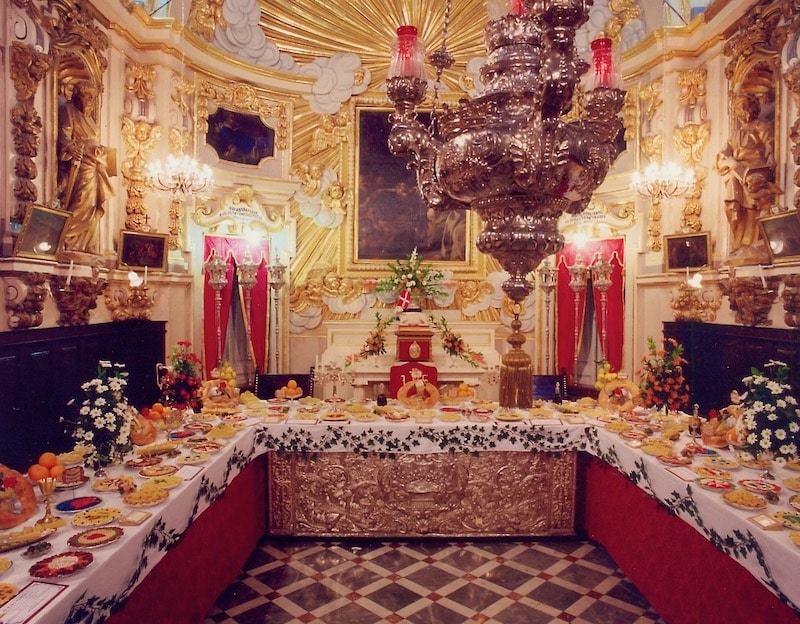
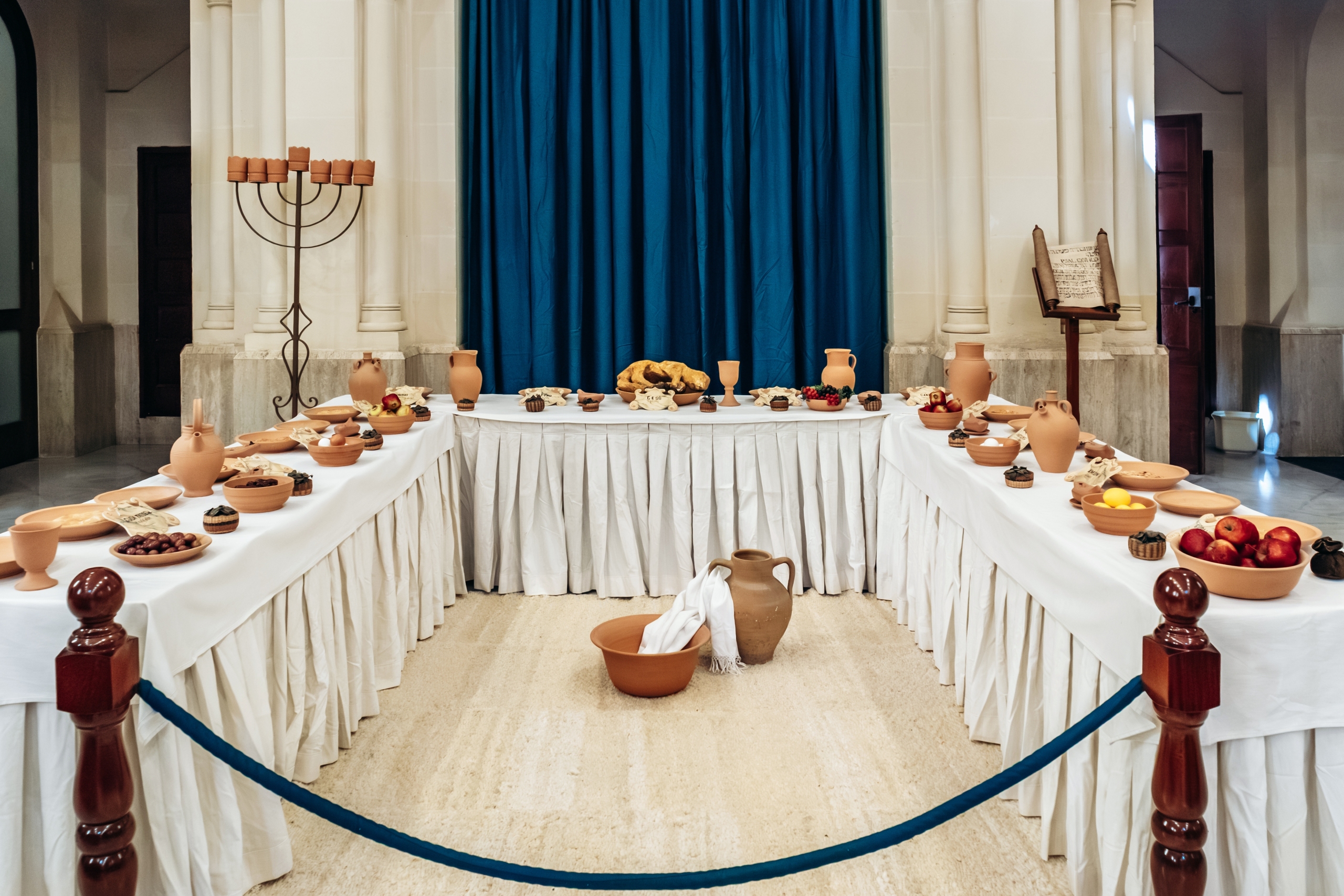
The Apostles’ Table is defined by its precise arrangement. Thirteen dishes are prepared, each corresponding to one of the twelve apostles and to Jesus. The table itself is typically covered in white linen and decorated with flowers and candles, creating a restrained but intentional visual setting.
The dishes are predominantly fish-based, reflecting the dietary practices associated with Lent. Common preparations include aljotta, a traditional fish soup; baked fish; and klamari mimlija, or stuffed calamari. Bread, vegetables, and wine accompany the main dishes, forming a balanced and regionally grounded menu.
Each plate is carefully identified, often through visual or culinary cues. Among the most notable is the representation of Judas Iscariot: a rice dish divided into thirty sections and coated in a metallic finish, referencing the thirty pieces of silver described in the narrative tradition. At the center of the table, a designated place represents Christ, marked by particular symbolic elements.
Before the meal begins, a blessing is pronounced and a passage from the Gospel of John is read aloud. This sequence establishes a rhythm that combines narrative recollection with shared participation. The act of naming each dish as it is presented reinforces the connection between the meal and its narrative framework.
Domestic and public expressions
While the Apostles’ Table can be prepared in private homes, it is equally present in public and semi-public spaces such as parish halls, oratories, and community centers. This dual setting reflects the flexibility of the tradition: it operates simultaneously within the intimate sphere of family life and the broader context of communal gathering.
In Valletta, the display organized at the Priory of St Dominic is often identified as one of the oldest continuous examples. Located within a historic urban fabric shaped by successive periods of rule, this site illustrates how the tradition has been preserved not as a static exhibit, but as a recurring, lived practice.
Across the islands, variations emerge in presentation and menu, yet the core structure remains consistent. This balance between continuity and adaptation is characteristic of Maltese cultural expressions more broadly, where inherited forms are reinterpreted through local and familial knowledge.
Food as transmission
A notable feature of the Apostles’ Table is the role of family recipes. Many of the dishes prepared for the occasion are drawn from culinary repertoires passed down through generations. These recipes carry with them not only techniques and ingredients, but also narratives of migration, adaptation, and memory.
In this sense, the table operates as a site of transmission. It preserves intangible heritage through repetition and variation, ensuring that each iteration remains connected to earlier ones while accommodating present circumstances. The visual elaboration of certain dishes—particularly rice compositions shaped or colored to convey meaning—demonstrates a form of edible craftsmanship that blends aesthetics with symbolism.
Charity and social function
Historical accounts emphasize the charitable dimension of the Apostles’ Table. In earlier centuries, the food prepared for the occasion was often distributed to individuals and families in need. This practice aligned with broader patterns of organized charity managed by religious confraternities and lay associations.
Although contemporary contexts differ significantly, elements of this social function persist. The preparation and sharing of food continue to reinforce networks of reciprocity and belonging. The table becomes a space where distinctions between host and guest are softened, and where participation carries both symbolic and practical significance.
Continuity in a changing context
Today, the Apostles’ Table remains an active component of Malta’s cultural calendar. Its endurance reflects the capacity of certain practices to adapt without losing structural coherence. While the social and institutional frameworks surrounding the tradition have evolved, the essential elements—communal gathering, symbolic food, and narrative reference—remain intact.
For observers and travelers, the Apostles’ Table offers insight into how ritual, cuisine, and history intersect within a specific place. It illustrates how a localized practice can encapsulate broader Mediterranean patterns while retaining distinctive features shaped by Malta’s particular trajectory.
In the context of pilgrimage routes that traverse the region, such traditions provide points of encounter beyond monumental sites. They invite attention to lived practices that continue to define community life. The Apostles’ Table, with its long continuity and layered meanings, stands as one such point—where food becomes a medium for history, and where a shared meal sustains both memory and connection.
This content comes to you in collaboration with VisitMalta
AI Transparency Notice
PilgriMaps uses artificial intelligence tools to assist in the research, drafting and translation of editorial content. All AI-assisted content is reviewed, edited and verified by our editorial team before publication. We contrast information against primary sources, specialist literature and on-the-ground knowledge to ensure accuracy, cultural sensitivity and editorial integrity.
AI is one tool among many in our workflow. The judgement, curation and responsibility for everything published on this platform remain entirely human.
Viator Media S.L. — in compliance with the EU Artificial Intelligence Act (Regulation EU 2024/1689).
This post is also available in: