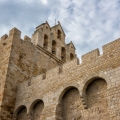
The Sacro Speco of Subiaco is an ancient Benedictine monastery located in a breathtaking natural setting in the Simbruini Mountains Regional Park. Built on the cave where, according to legend, St. Benedict lived in the 6th century, this monastery is a historical and spiritual testimony of great importance. Its structure, set in the rock face of Mount Taleo, consists of nine high arches that support a complex network of interior rooms, including small churches and chapels, some dug directly into the rock.
The significance of the Sacro Speco on the Way of St. Benedict is undeniable. Not only does this place represent the place where St. Benedict retired to devote himself to the spiritual life, but it also houses a rich collection of frescoes illustrating the Passion of Christ, the life of the Virgin and the life of St. Benedict himself. Particularly noteworthy are the beautifully preserved pictorial cycles from the 13th and 14th centuries. In addition, the Sacro Speco holds the oldest known portrait of St. Francis of Assisi, making it a landmark not only for devotees of St. Benedict, but also for those interested in the history of monasticism and Christian spirituality.
- Address
Via S. Benedetto, snc, Subiaco, Italy
- Web
https://monasterosanbenedettosubiaco.it/en/ - Visiting Hours
Daily from 9.30 to 12.15 and from 3.30 pm to 5.15 pm (winter days) and to 6.15 pm (summer days) - What to see
Frescoes, St Francis’ portrait
AI Transparency Notice
PilgriMaps uses artificial intelligence tools to assist in the research, drafting and translation of editorial content. All AI-assisted content is reviewed, edited and verified by our editorial team before publication. We contrast information against primary sources, specialist literature and on-the-ground knowledge to ensure accuracy, cultural sensitivity and editorial integrity.
AI is one tool among many in our workflow. The judgement, curation and responsibility for everything published on this platform remain entirely human.
Viator Media S.L. — in compliance with the EU Artificial Intelligence Act (Regulation EU 2024/1689).
This post is also available in: