In the early decades of the 20th century, a young man from Turin began tracing his own kind of pilgrimage through the landscapes of modern Italy. Pier Giorgio Frassati (1901–1925)—student, mountaineer, and advocate for the poor—moved between city streets, alpine valleys, and sanctuaries with an intensity that turned ordinary travel into a form of spiritual geography. His life, though brief, mapped the journey of a modern pilgrim: restless yet rooted, social yet deeply interior, devoted to motion as a way of understanding faith and responsibility.
A life in motion
Born into an influential Turinese family—his father, Alfredo Frassati, founded La Stampa and later served as ambassador to Germany—Pier Giorgio’s upbringing was one of privilege balanced by discipline. Yet he gravitated toward a very different world: the working-class neighborhoods of Turin and the mountain paths of the Piedmontese Alps. As an engineering student, he devoted his free hours to serving the poor, visiting the sick, and organizing charity work with friends.
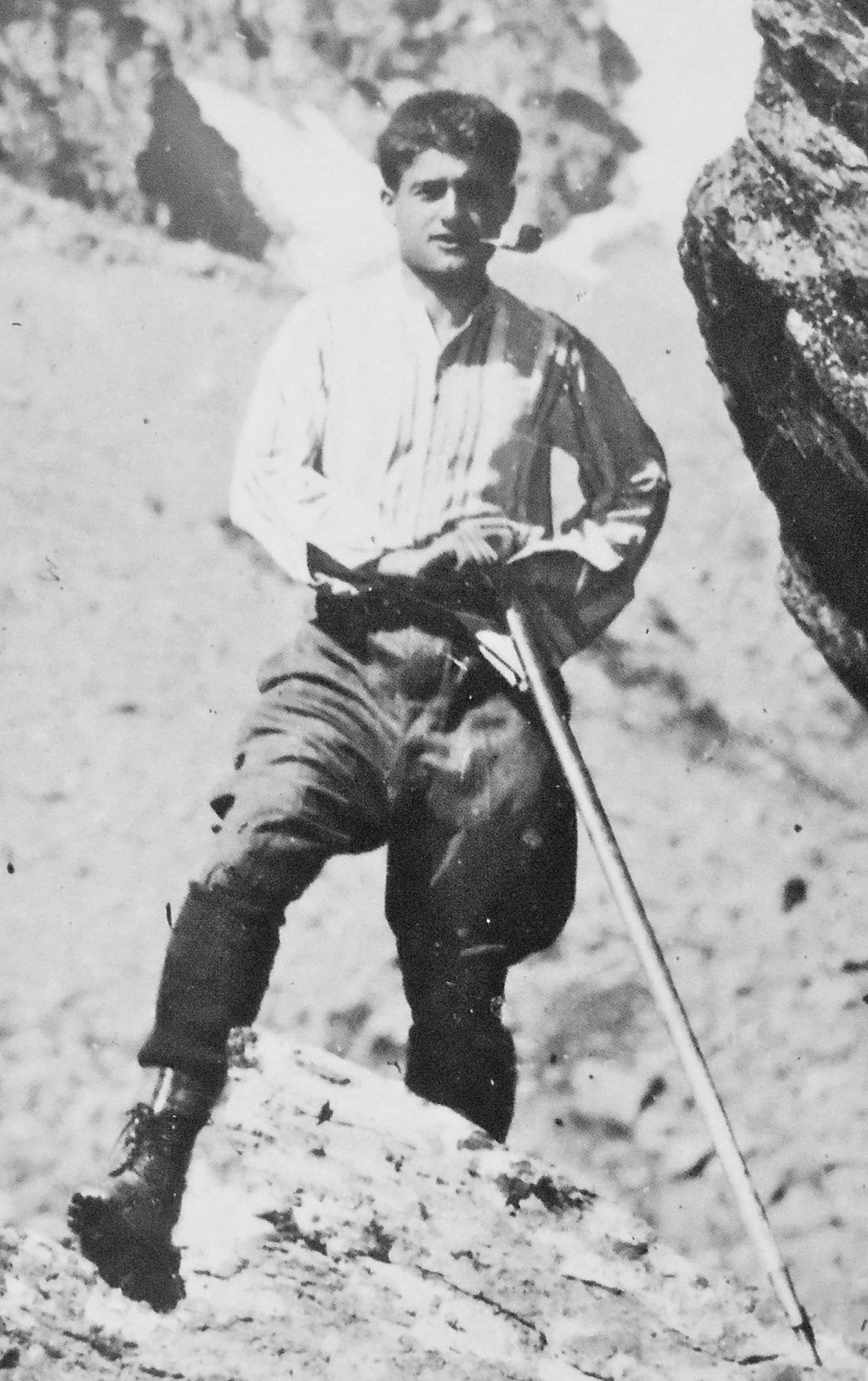
His contemporaries remembered him as perpetually in motion: traversing the city on foot or bicycle, traveling by train to visit industrial towns, and climbing in the high valleys each summer. For Frassati, these were not diversions but essential routes of encounter. His geography of service and ascent gave tangible form to an inner search.
Pilgrimage in the everyday
Frassati’s notion of pilgrimage did not depend on distant destinations. It unfolded across familiar spaces—the narrow alleys of Turin, the steep trails above Pollone, and the sanctuaries of the Piedmontese landscape. He found meaning in physical effort, in companionship, and in silence.
His mountain excursions often took on the character of a liturgy of movement. Friends recalled him pausing mid-climb to pray or to assist slower companions, transforming the act of ascent into a collective meditation. In letters, he described the mountains as “a meeting place with God,” a phrase that would come to define his understanding of nature and faith.
Oropa: Sanctuary and ascent
Among the places most closely tied to Frassati’s personal pilgrimages stands the Sanctuary of Our Lady of Oropa, near Biella in northern Piedmont. Nestled among wooded slopes beneath the massif of Monte Mucrone, Oropa has been a Marian shrine since the 17th century, renowned for its statue of the Black Madonna and its long history of mountain pilgrimage.
According to piergiorgiofrassati.net and the Santuario di Oropa, Frassati had a special relationship with this place. During his summer stays in Pollone, his family’s home village nearby, he often rose early to climb to Oropa before the household awoke. There, in the stillness of dawn, he prayed before the image of the Virgin, entrusting his life and those he loved to her protection. The sanctuary became for him both a refuge and a point of renewal—a convergence of mountain, silence, and devotion.
At Oropa, Frassati deepened his devotion to the Virgin Mary and found a setting where his two strongest inclinations—faith and the love of the mountains—met naturally. The climb itself became a ritual of endurance and gratitude. Sources from the Santuario di Oropa emphasize how the sanctuary embodied his understanding of prayer: rooted in landscape, strengthened by effort, and shaped by beauty.
The connection endures. Oropa remains a site of remembrance for those who follow Frassati’s example, hosting events and pilgrimages inspired by his life. During the Jubilee of 2025, the sanctuary became a focal point of celebrations marking his canonization, reaffirming its role as a place where personal faith and communal journey intersect.
The Alpine road
Frassati’s mountaineering companions—his circle known humorously as the Tipi Loschi (“the Shady Characters”)—often joined him in climbs through the Valle d’Aosta and the Biellese Alps. Their outings combined humor and discipline, physical challenge and contemplation. For Frassati, to climb was to align one’s spirit with clarity and perseverance. “The higher we go,” he wrote, “the better we shall hear the voice of the wind, the clearer we shall see the world.”
His photographs from these journeys—some taken near Oropa and the surrounding peaks—capture him smiling against the alpine sky, often with a rosary looped around his wrist or a prayer book tucked in his jacket. They reveal an understanding of travel not as escape but as encounter with what he called “the great silence of creation.”
The city and the ascent
Back in Turin, Frassati transformed daily life into a different form of pilgrimage. The city’s hospitals, schools, and tenements became stations of service. He visited the poor, distributed food, and advocated for workers, moving through the industrial neighborhoods with the same deliberation he brought to mountain paths. His outward journeys mirrored an inward discipline—a search for coherence between belief and action.
This rhythm of ascent and return, mountain and city, shaped a distinct spiritual pattern. The sanctuary of Oropa and the streets of Turin were not opposites but complements, representing the two dimensions of his path: contemplation and solidarity.
Legacy
When Pier Giorgio Frassati died in 1925, at just twenty-four, his family expected a quiet funeral. Instead, crowds of Turin’s poor and working-class citizens filled the streets to honor him. In the decades that followed, his example inspired youth movements and modern interpretations of pilgrimage as active compassion.
Today, those who visit Pollone and Oropa can retrace his steps: the early morning climb, the silent chapel, the descent into daily service. The sanctuary, framed by mountains he loved, stands as a monument not to withdrawal but to engagement—a place where contemplation becomes the prelude to action.
Frassati’s life suggests that pilgrimage need not lead to a distant shrine. It can unfold across the landscapes of one’s own world, where prayer, movement, and service converge. From the slopes of Oropa to the streets of Turin, he traced a map of the possible—a modern pilgrim who found the sacred not in departure, but in return.
AI Transparency Notice
PilgriMaps uses artificial intelligence tools to assist in the research, drafting and translation of editorial content. All AI-assisted content is reviewed, edited and verified by our editorial team before publication. We contrast information against primary sources, specialist literature and on-the-ground knowledge to ensure accuracy, cultural sensitivity and editorial integrity.
AI is one tool among many in our workflow. The judgement, curation and responsibility for everything published on this platform remain entirely human.
Viator Media S.L. — in compliance with the EU Artificial Intelligence Act (Regulation EU 2024/1689).
This post is also available in: