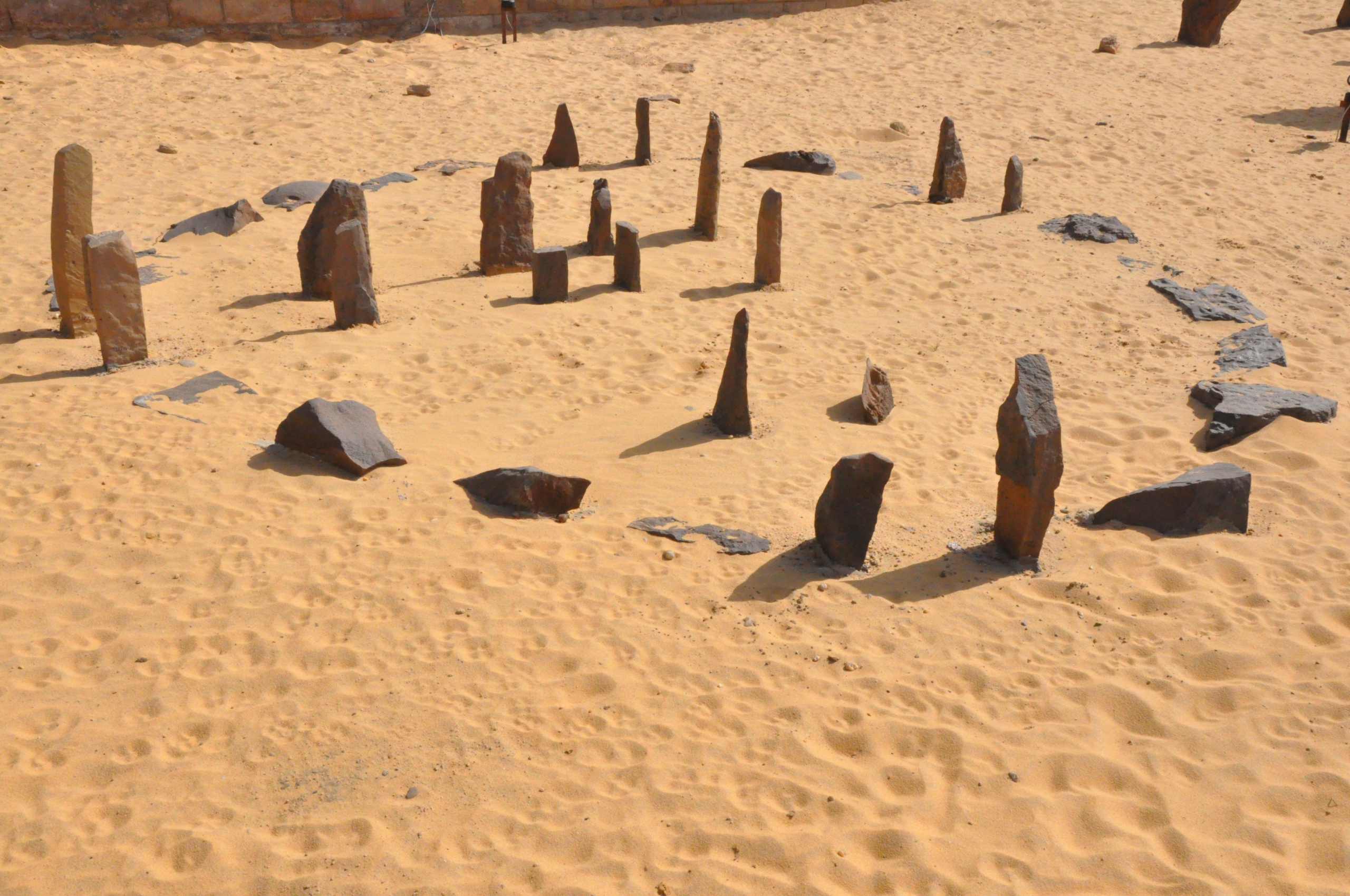
In the remote expanse of southern Egypt’s Nubian Desert, near the modern border with Sudan, Nabta Playa offers one of the most compelling archaeological records of human activity in the Eastern Sahara during the early Holocene (ca. 7500–3000 BCE). Today it appears as a dry basin, but during wetter climatic phases it held seasonal lakes that supported pastoral communities. These groups left behind a landscape marked by stone structures, tumuli, and carefully arranged megaliths.
The site has often been described in popular literature as an early “pilgrimage center.” A closer examination, however, suggests a more nuanced interpretation—one that situates Nabta Playa within patterns of seasonal movement, ritualized gathering, and environmental adaptation rather than organized pilgrimage in the later, institutional sense.
Environmental context and mobility
Nabta Playa’s significance emerges from its ecological setting. During the African Humid Period, monsoon systems extended northward, transforming what is now hyper-arid desert into a mosaic of grasslands and ephemeral lakes. Pastoral groups moved across this landscape with cattle, exploiting seasonal water sources. Archaeological evidence—such as hearths, ceramics, and animal remains—indicates repeated, though not permanent, occupation.
Mobility structured life in this region. Rather than fixed settlements, communities followed cyclical routes tied to rainfall and grazing conditions. Nabta Playa appears to have been one of several key nodes within this network. Its recurrent use suggests that it functioned as a predictable gathering place, where dispersed groups could converge at certain times of year.
Monumentality in a seasonal landscape
Among Nabta Playa’s most studied features are its megalithic alignments and stone circles, dated to roughly the 5th millennium BCE. These constructions, modest in scale compared to later monuments elsewhere, nonetheless demonstrate careful planning. Some alignments appear oriented toward solar events, particularly the summer solstice, when the return of rains would have been anticipated.
Nearby, archaeologists have documented tumuli—stone-covered mounds—containing cattle remains and, in some cases, human burials. The deposition of cattle, a resource central to subsistence and social identity, indicates practices that extended beyond utilitarian concerns. These features point to a symbolic landscape in which certain locations were repeatedly marked, revisited, and perhaps imbued with shared meanings.
Abu Simbel: An ancient pilgrimage to the edge of the Egyptian empire
Gathering or pilgrimage?
The question of whether Nabta Playa functioned as a pilgrimage center depends largely on how “pilgrimage” is defined. In later historical contexts—such as classical Mediterranean sanctuaries or medieval routes—pilgrimage involves travel to a recognized sacred destination, often supported by institutional frameworks and shared doctrinal narratives.
At Nabta Playa, the evidence does not support such formalization. There are no indications of permanent structures dedicated to hosting visitors, nor of centralized authority organizing ritual activity. Instead, what emerges is a pattern of seasonal aggregation. Groups likely arrived as part of broader subsistence cycles, converging when environmental conditions allowed.
Ritual practices were clearly present. The construction of alignments, the burial of cattle, and the repeated use of specific locations suggest coordinated activities that may have included ceremonies linked to seasonal change or social cohesion. However, these practices appear embedded within everyday life rather than separated into a distinct category of religious journey.
A proto-pilgrimage landscape?
Rather than labeling Nabta Playa a pilgrimage center, it may be more accurate to describe it as a “ritual aggregation site.” This term acknowledges both movement and meaning without imposing later institutional models. The act of traveling to Nabta Playa—whether driven by ecological necessity or social custom—likely carried symbolic dimensions. Movement itself can generate shared identity, especially when tied to recurring destinations.
In this sense, Nabta Playa contributes to a broader understanding of how early human societies structured space and time. The convergence of dispersed groups, the marking of landscapes with enduring features, and the alignment of activities with celestial cycles all point to forms of collective experience that anticipate later pilgrimage traditions without fully corresponding to them.
Rethinking pilgrimage in deep time
Nabta Playa invites a reconsideration of pilgrimage as a category. If defined too narrowly, the concept excludes early forms of ritual movement that lack written records or institutional frameworks. If defined too broadly, it risks obscuring important differences between prehistoric and historical practices.
The site demonstrates that long before the emergence of formal religious systems, humans were already organizing journeys that combined practical needs with symbolic expression. Seasonal travel to resource-rich areas could coincide with moments of social gathering, ritual performance, and landscape marking. These activities created continuity across generations, embedding memory into place.
Nabta Playa stands as a testament to the interplay between environment, mobility, and ritual in the ancient world. While it does not meet the criteria of a pilgrimage center in the conventional sense, it reveals how early societies structured meaningful movement across landscapes. Its stone alignments and burial features do not simply mark a place; they record repeated acts of return.
In this way, Nabta Playa occupies an important position in the long history of human journeys. It reflects a stage in which travel, survival, and symbolic practice were closely intertwined—offering insight into how the impulse to gather, remember, and mark significant places emerged long before the formalization of pilgrimage routes.
AI Transparency Notice
PilgriMaps uses artificial intelligence tools to assist in the research, drafting and translation of editorial content. All AI-assisted content is reviewed, edited and verified by our editorial team before publication. We contrast information against primary sources, specialist literature and on-the-ground knowledge to ensure accuracy, cultural sensitivity and editorial integrity.
AI is one tool among many in our workflow. The judgement, curation and responsibility for everything published on this platform remain entirely human.
Viator Media S.L. — in compliance with the EU Artificial Intelligence Act (Regulation EU 2024/1689).
This post is also available in: