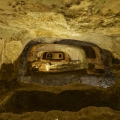
The church of Nuestra Señora de la Asunción, located in the Plaza de la Constitución in Oropesa, Toledo, is an outstanding example of religious architecture that spans several styles, reflecting the transition from Plateresque to Renaissance during the 16th and 17th centuries. Designed by the architect Francisco de Mora, this temple stands on a previous Romanesque structure, which in turn was built on a former mosque. The church has a Latin cross plan with a single nave divided into three bays and a five-sided polygonal apse. The covering includes barrel vaults in the body and arms, a dome in the transept and a quarter sphere cap in the Main Chapel. The tower, attached to the west side of the temple, consists of two bodies, the second housing the bell tower, and is distinguished by its linteled roof with Renaissance balustrade, gargoyles and Gothic pinnacles.
The main access to the temple is through a 17th century Baroque doorway, which stands out for its semicircular arch framed by Plateresque columns and an entablature decorated with fantastic animals and heraldic motifs of the House of Oropesa. The north and south facades have access doors that, although functional, lack significant artistic interest. Inside, the sober decoration of the transept, formed by four pairs of half columns attached to the angles, enhances the architectural structure. The choir, located at the foot of the church, is elevated above the arch. The main nave has chapels in its first and third bays, accessible through semicircular arches and covered by lowered barrel vaults. On the exterior, the building combines ashlar and masonry, and preserves the remains of the passageway that connected with the Palace of the Counts of Oropesa.
- Address
Pl. Constitución, Oropesa, Toledo - Web
None - Visiting Hours
Unknown - What to see
Plateresque-style inside
AI Transparency Notice
PilgriMaps uses artificial intelligence tools to assist in the research, drafting and translation of editorial content. All AI-assisted content is reviewed, edited and verified by our editorial team before publication. We contrast information against primary sources, specialist literature and on-the-ground knowledge to ensure accuracy, cultural sensitivity and editorial integrity.
AI is one tool among many in our workflow. The judgement, curation and responsibility for everything published on this platform remain entirely human.
Viator Media S.L. — in compliance with the EU Artificial Intelligence Act (Regulation EU 2024/1689).
This post is also available in: