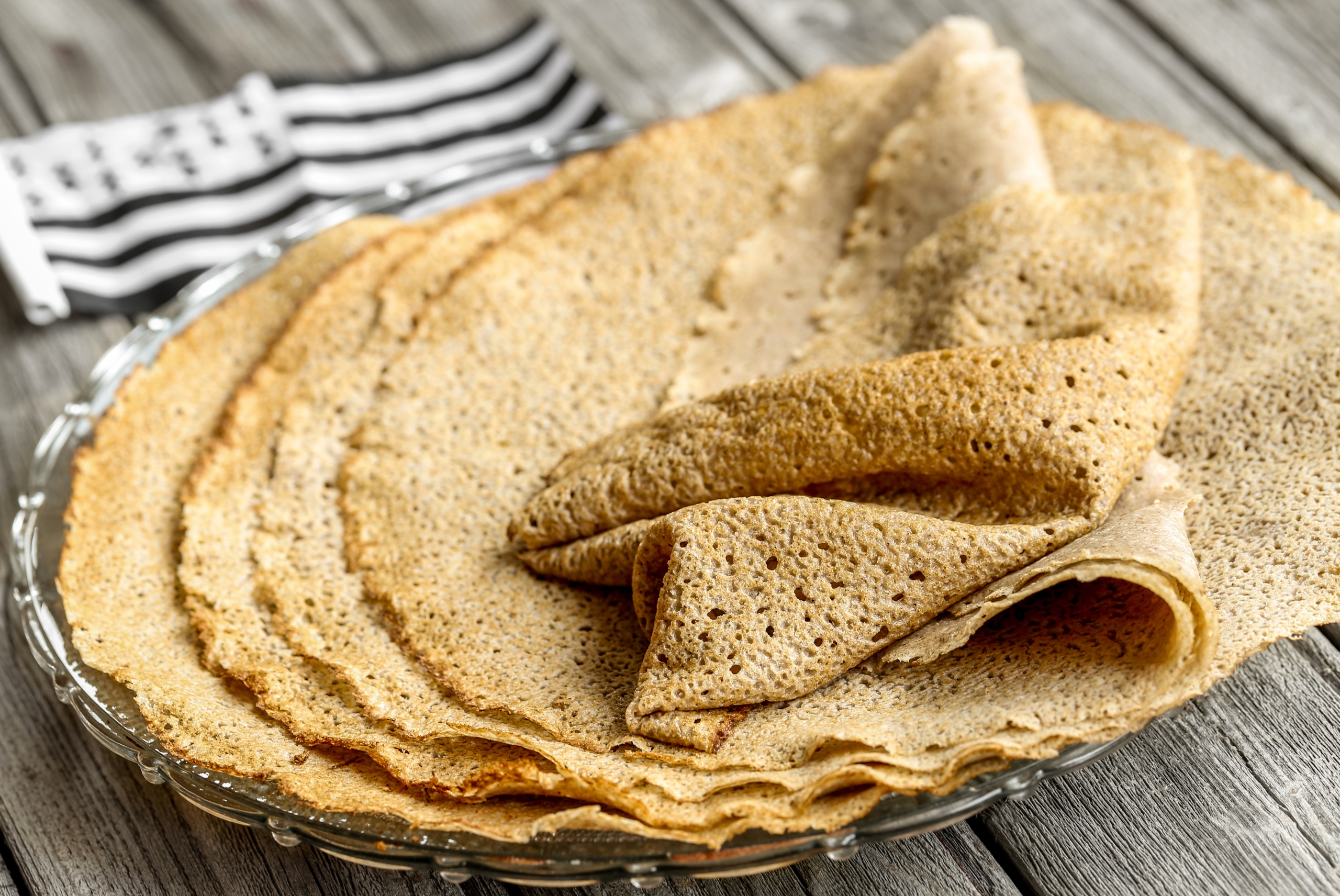
Some dishes nourish. Others tell stories. Breton galettes do both. These buckwheat crêpes feed the body while engaging memory and attention through their distinctive color, texture, and restraint. Their appeal is immediate and enduring.
Prepare accordingly. This article may cause hunger.
What exactly is a Breton galette?
Let’s begin with the essentials. A Breton galette is a savory crêpe from Brittany, made with just three ingredients: buckwheat flour (blé noir), water, and salt. Nothing else.
Its color is grey-brown, almost lunar. The flavor is nutty, slightly bitter, unmistakable. The texture balances crisp edges with a soft center. It is a study in contrast and control.
Once a subsistence food, the galette became a regional emblem. A dish associated with poverty that later entered refined kitchens. Simplicity, refined through practice.
A Crusader, pink flowers, and an unlikely crop
To understand the galette, imagination helps. Picture the 12th century CE. A weary knight returns from the Crusades. Instead of gold or spices, he carries seeds from a plant with pink blossoms encountered in Asia: buckwheat.
Known in French as blé noir, buckwheat reached Brittany through medieval trade routes and expanded significantly under the reign of Anne of Brittany in the 16th century CE. The region’s acidic soils and humid climate proved ideal. Buckwheat thrived where wheat failed.
The irony is botanical. Buckwheat is not a grain at all, but a pseudocereal related to rhubarb. For Breton farmers, taxonomy mattered less than survival.
The bread of the poor
The galette emerged as an affordable, filling staple. Early versions consisted of buckwheat flour mixed with water and salt, cooked on flat stones heated by wood fires. It functioned as bread for those who could not afford bread.
From the 15th century onward, cooking shifted to the bilig, a cast-iron griddle still used today. The term galette likely derives from galet, meaning pebble – an unpretentious origin for an unpretentious food.
Execution, however, required skill. Batter was spread using a wooden tool called a rozell, with a swift, circular motion. By the mid-19th century, Rennes counted more than 130 professional galettières. By 1900, nearly 400 operated in the city – one for every 150 residents.
The galette was democratic. Filling. Reliable.
The galette is not a crêpe (and that matters)
Within Brittany, this distinction is essential.
In Upper Brittany, galette refers to savory buckwheat crêpes. Crêpe designates sweet versions made with wheat flour. This separation solidified after 1850.
The difference extends beyond ingredients. The galette is rustic and structured, with crisp edges and a pliant center. Its surface shows small holes that trap salted butter like lunar craters. The crêpe is thinner, paler, and more delicate.
Both belong to Brittany. Neither is superior. They are simply not the same.
Why buckwheat deserves attention
Beyond flavor, buckwheat offers notable nutritional qualities. It is naturally gluten-free, suitable for people with celiac disease or gluten sensitivity.
Nutritionally, it provides sustained energy through complex carbohydrates and proteins with a high biological value, containing essential amino acids that support muscle function. It also supplies iron, magnesium, potassium, selenium, zinc, copper, and B vitamins.
With a low glycemic index (around 40), buckwheat suits diabetic diets, while its fiber content supports digestive and cardiovascular health.
In practical terms: galettes are both satisfying and functional.
The traditional recipe: Three ingredients and patience
The classic galette reflects culinary minimalism.
Ingredients (8–10 galettes):
250 g buckwheat flour
500 ml water
5 g salt (Guérande salt, if available)
Method:
Mix flour and salt in a large bowl. Gradually add water, whisking vigorously until the batter is fluid but substantial. Refrigerate for at least two hours; overnight rest is preferred.
Heat a pan or bilig over medium-high heat. Grease lightly with salted butter. Pour a ladle of batter and spread quickly in a circular motion. Cook until the edges lift and turn golden, then flip briefly.
Done.
A note on tradition: adding an egg improves color. Purists object. Pragmatists approve.
The galette complète
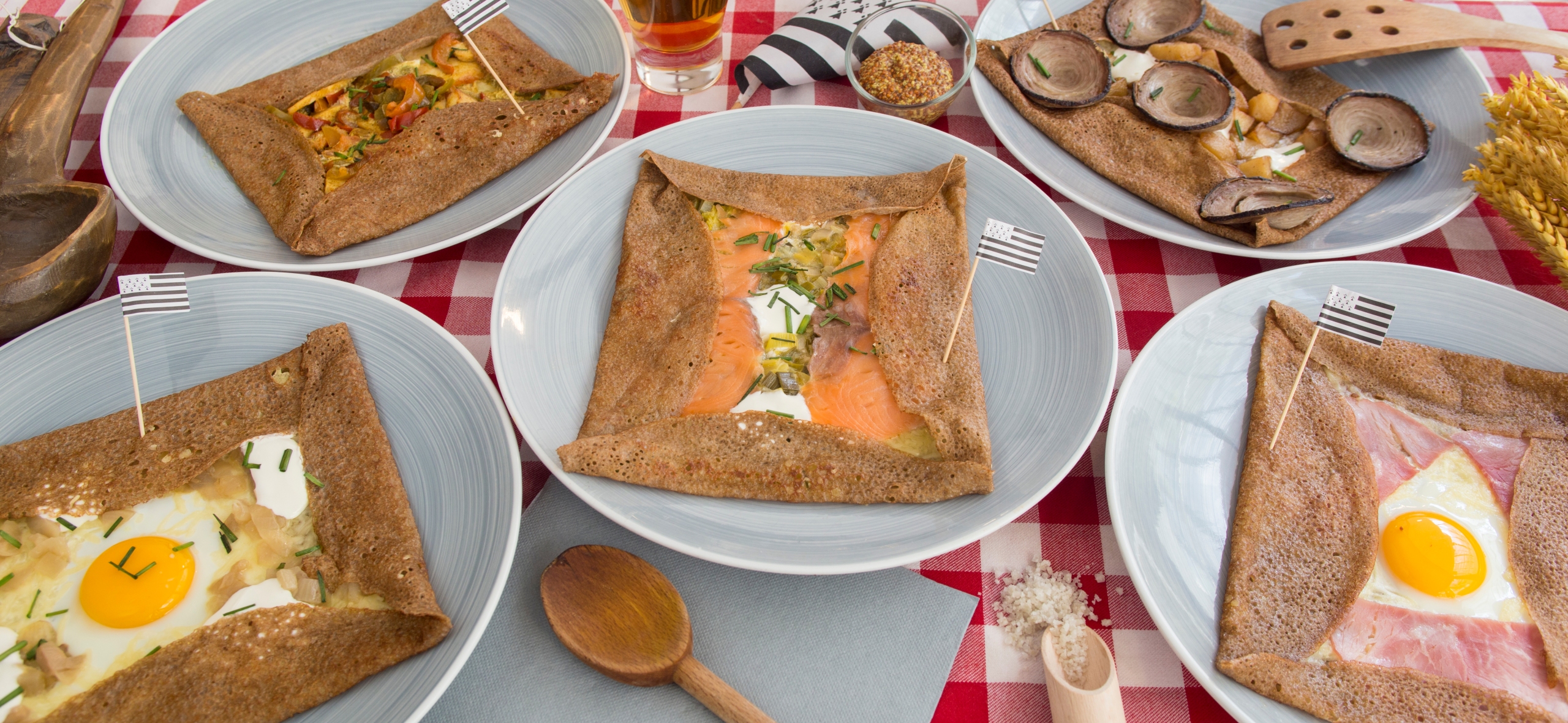
The most recognized version is the galette complète: cooked ham, grated cheese, and a sunny-side-up egg placed directly onto the galette as it cooks.
The four edges are folded inward, framing the egg at the center. When cut, the yolk flows into the filling. Crisp, molten, deliberate.
Interestingly, this version dates only to the 1960s. Earlier generations ate galettes simply with salted butter or crumbled them into lait ribot (fermented buttermilk).
Galette-saucisse: Brittany’s original street food
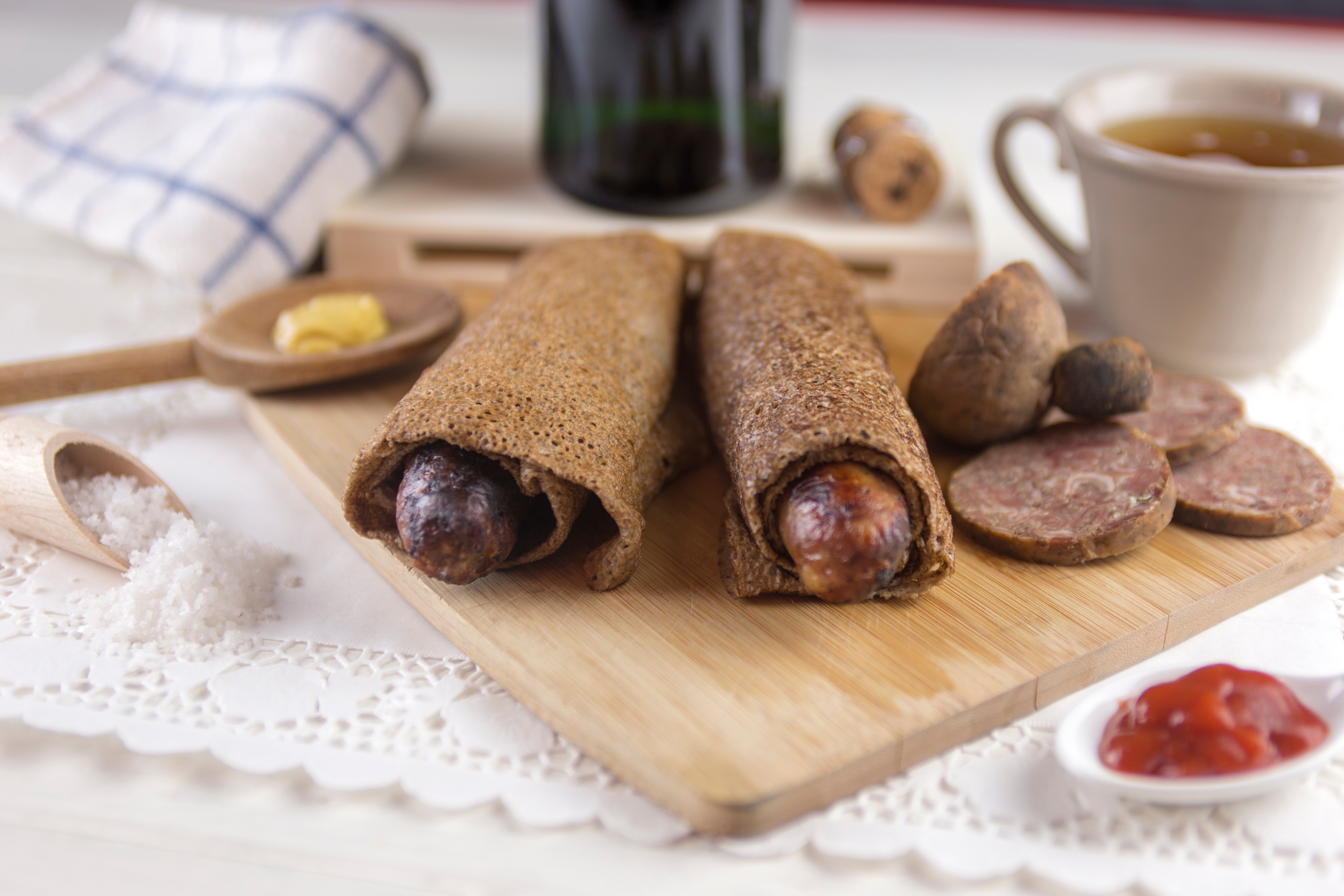
Before the hot dog, there was the galette-saucisse.
A pork sausage wrapped in a buckwheat galette, seasoned only with salt and pepper. No condiments. It remains the emblematic stadium food of Stade Rennais supporters.
Portable, affordable, and eaten outdoors – often in the rain – it expresses food as shared experience.
Creative variations
Over time, the galette has absorbed outside influences. Popular variations include forest mushrooms with cream, scallops with leeks, raclette-style fillings, smoked salmon with dill, vegetarian combinations, and sweet-savory contrasts such as pear with blue cheese.
These adaptations demonstrate flexibility without erasing identity.
Folding as final gesture
How a galette is folded shapes how it is eaten:
- Wallet fold: four edges inward, filling visible
- Half-moon: folded once, informal
- Roll: practical for street food
- Triangle: layered folds for formal presentation
Timing matters. Fold before the galette becomes too crisp.

Protection and the IGP label
In 2018, the Breton galette received Indication Géographique Protégée status. The designation requires buckwheat grown in Brittany and adherence to traditional methods.
This matters. Today, around 70% of buckwheat consumed in France is imported. The IGP supports local producers and culinary continuity.
One galette, one cider, one approach to life
A galette is traditionally paired with Breton cider – sweet or brut – served in a ceramic bowl (bolée). Its acidity balances butter and cheese, completing the experience.
Alternatives include local beer, dry white wine such as Muscadet, or lait ribot for traditionalists.
The Breton galette endured scarcity, gained recognition, and secured legal protection. It remains what it has always been: flour, water, salt, and a collective skill refined over generations.
Trying it at home is enough to understand why.
AI Transparency Notice
PilgriMaps uses artificial intelligence tools to assist in the research, drafting and translation of editorial content. All AI-assisted content is reviewed, edited and verified by our editorial team before publication. We contrast information against primary sources, specialist literature and on-the-ground knowledge to ensure accuracy, cultural sensitivity and editorial integrity.
AI is one tool among many in our workflow. The judgement, curation and responsibility for everything published on this platform remain entirely human.
Viator Media S.L. — in compliance with the EU Artificial Intelligence Act (Regulation EU 2024/1689).
This post is also available in: