Within the intricate urban fabric of Old Cairo—where market scents blend with the echoes of ancient prayers and the stone blocks of past civilizations surface beneath visitors’ feet—stands a church that embodies one of the most enduring and compelling narratives of Christian tradition: the Church of Abu Serga, also known as the Church of Saints Sergius and Bacchus.
Beyond its archaeological significance and architectural appeal, this site functions above all as a place of memory. According to Coptic tradition, the Holy Family found refuge here during their flight into Egypt. Over time, this narrative has moved beyond its religious framework to become a cultural symbol and a form of living heritage.
The cave beneath the church
Tradition holds that Mary, Joseph, and the child Jesus rested for a relatively extended period—around three months—in a cave near the Nile, after weeks of continuous and hazardous travel following their arrival in Egypt.
Having come from Haret Zuweila, now also part of Cairo, they are said to have found shelter near an urban settlement (Fustat) which, shortly thereafter, would be reinforced by the emperor Trajan with the construction of the Fortress of Babylon, adjacent to the ancient Canal of the Pharaohs.
Above this cave, venerated from an early period by Christian communities, a church was built that is now regarded as one of the oldest still standing. Beneath the floor of the present structure lies a crypt identified as the place where the Holy Family is believed to have stayed.
Nearby, an ancient well marks—according to tradition—the spot from which they drank. These elements reinforce the devotional narrative of the site and position it as a central destination along the route known as the Holy Family Trail in Egypt.
Old Cairo: a place of encounters
The Church of Abu Serga forms part of the Coptic Quarter in Old Cairo, an area where Christian, Jewish, and Islamic traditions have coexisted for centuries. Recognized as a UNESCO World Heritage Site in 1979, this sector preserves remains of the ancient Fortress of Babylon alongside early Christian churches, historic synagogues, and medieval mosques.
Cobblestone streets, reused Roman walls, and centuries-old sanctuaries create an urban landscape where layers of time appear superimposed. In this context, Abu Serga is not an isolated monument but a key element in the interreligious and cultural exchanges that have shaped the identity of historic Cairo. Its location within the so-called Magmoa El Adyan—“Complex of Religions”—highlights its role as a witness to centuries of social and spiritual transformation.
Saints Sergius and Bacchus: martyrs and patrons
Although the subterranean crypt draws much of the attention, the church’s name refers to two early Christian martyrs: Sergius and Bacchus, Roman soldiers executed in the 4th century CE for refusing to renounce their beliefs during the persecutions under Emperor Maximian.
Originating in the Eastern regions of the Roman Empire, their veneration spread rapidly across Christian communities of the eastern Mediterranean. In Egypt, where religious persecution was particularly intense during the Roman period, figures such as Sergius and Bacchus came to represent ideals of loyalty and endurance.
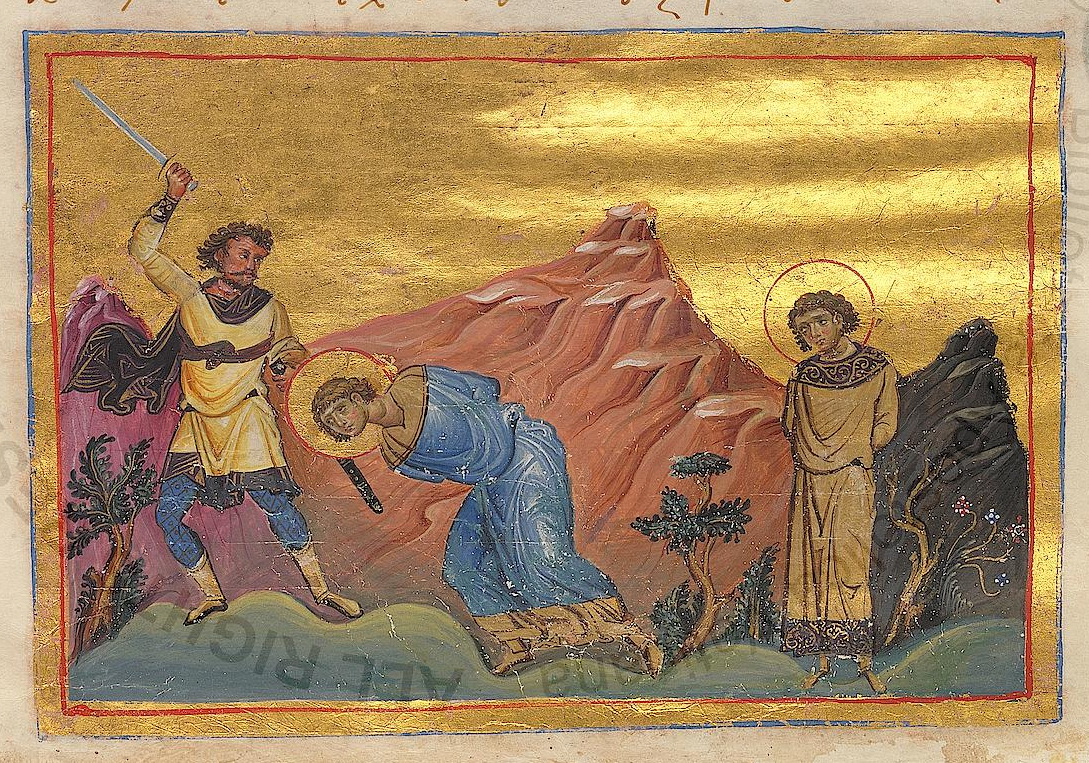
According to tradition, the church once housed some of their relics, though no documentation confirms this. Their association reinforces the link between the building’s architecture and the broader memory of early Christian martyrdom.
A millennium of reconstruction
The material history of Abu Serga is as layered as its symbolic meaning. Its traditional foundation is attributed to Athanasius, a Christian official of the Umayyad court, in the late 7th century CE. However, archaeological studies suggest that parts of the structure may date back to Late Antiquity (4th–5th centuries CE).
Over the centuries, the church has endured fires, looting, and repeated restorations. It suffered severe damage during the great fire of Fustat in 750, was rebuilt under the Abbasids, repaired again in 1073 by the Coptic official Ibn al-Ibha during the Fatimid period, and restored following another fire in 1171 under Saladin. This structural resilience has secured its recognition as one of the oldest Coptic churches still in use.
Between the 7th and 11th centuries, Abu Serga also served as a site for the selection and enthronement of Coptic patriarchs, including Isaac and Shenouda I, granting it institutional prominence within the Coptic Orthodox Church.
A Coptic basilica with an ancient soul
Architecturally, Abu Serga follows the model of Coptic-Byzantine basilicas: three naves separated by columns, an entrance narthex, and a trilobed eastern apse. Despite its modest dimensions—approximately 30 meters in length—the interior conveys a strong symbolic language. The pitched wooden roof, for instance, is often interpreted as an allusion to Noah’s Ark.
Inside, the church contains a carved wooden iconostasis inlaid with geometric motifs, altars dedicated to various saints, a marble pulpit, and upper chapels used for prayer and penitence. Many of the columns are repurposed from Roman structures, reinforcing the idea of a building constructed atop earlier remains in dialogue with the site’s long history.
An additional tradition concerns the so-called “bleeding column.” According to Coptic accounts, during Holy Week in 1967, one of the columns—second from the west—began to emit what appeared to be blood. Witnesses reported the घटना to Pope Kyrillos VI, who is said to have touched the stone, stopping the flow. The column remains an object of local veneration.

The crypt and its layers
The subterranean crypt—also referred to as the “cave church”—is the most intimate and evocative space within the complex. It consists of three small vaulted aisles supported by slender columns, with a modest altar at the eastern end aligned according to liturgical orientation. Tradition identifies a stone slab here as the place where the child Jesus rested, a detail that, regardless of historical verification, deepens the site’s symbolic resonance.
Although its current structure likely dates to the 11th century, some researchers suggest that the crypt replaced an earlier sanctuary, possibly in use as early as the 2nd or 3rd centuries CE. This hypothesis would position Abu Serga among the oldest continuously used Christian sites in the world.
Archaeology and research
Recent restoration efforts have allowed archaeologists and historians to explore the multiple layers of the church. Notable findings include early baptisteries, Roman walls incorporated into the structure, medieval wall paintings, and decorative fragments uncovered beneath later additions.
A stone block from Trajan’s Roman canal, discovered during excavations, points to the broader and more dynamic urban landscape that once surrounded the site in antiquity.
Conservation projects carried out between 1999 and 2004 with Spanish participation, followed by further work completed in 2016, have stabilized the structure, reduced water infiltration in the crypt, and revealed previously hidden artistic elements. These efforts have made it possible to appreciate Abu Serga in its full historical complexity.
The Holy Family Route today: A living itinerary across Egypt
A threshold across centuries
Today, Abu Serga remains an active church: a place of worship, a pilgrimage destination, and a point of interest within historic Cairo. Its doors are open to worshippers, researchers, and visitors alike, offering a testament to religious continuity, architectural heritage, and Egyptian Christian identity.
Each year on June 1, marking the commemoration of the Holy Family’s entry into Egypt, the church becomes the setting for celebrations that extend beyond the local community. Its inclusion in cultural itineraries promoted by the Ministry of Tourism, alongside its protection as a historic monument, underscores its dual role as both devotional site and cultural heritage.
The Church of Abu Serga stands as a threshold across centuries, where history and tradition, architecture and lived experience, memory and present-day life intersect. Its crypt—dim and quiet—continues to evoke a narrative of movement and refuge that resonates beyond any single tradition: a search for shelter, meaning, and continuity. In the vibrant heart of Old Cairo, Abu Serga endures as a place where the intangible feels within reach.
AI Transparency Notice
PilgriMaps uses artificial intelligence tools to assist in the research, drafting and translation of editorial content. All AI-assisted content is reviewed, edited and verified by our editorial team before publication. We contrast information against primary sources, specialist literature and on-the-ground knowledge to ensure accuracy, cultural sensitivity and editorial integrity.
AI is one tool among many in our workflow. The judgement, curation and responsibility for everything published on this platform remain entirely human.
Viator Media S.L. — in compliance with the EU Artificial Intelligence Act (Regulation EU 2024/1689).
This post is also available in: