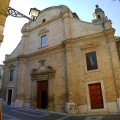
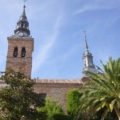
The hermitage of Sant’Angelo in Asprano, also known as the rock church of San Michele, is located in a large protected natural cave under the mountain overlooked by the imposing remains of the castle of the counts of Aquino, near the hamlet of Caprile in Roccasecca. This hermitic refuge dates back to at least the 10th century, with the first recorded mention in December 988, when Grimoaldo, judge of Aquino, donated it to the abbey of Montecassino. It is believed that the cave was initially a refuge for hermits and that, over time, a Benedictine monastic community developed there. The hermitage includes a church with a small apse and is adorned with precious Byzantine and Benedictine-style frescoes from the 11th-12th centuries. These include a Christ Pantocrator in the mandorla, flanked by angels and apostles, and a depiction of the Virgin in an attitude of prayer.
The frescoes in the hermitage, recently restored, are of great artistic and historical importance. In the main apse, Christ Pantocrator is depicted blessing with his right hand and holding an open book with his left, surrounded by angels and apostles. In another fresco, the remains of an unusual Crucifixion, possibly from the 9th century, were discovered, showing a Christ dressed in a tunic and a Longinus with a rope instead of a spear. This fresco was transferred to the church of Santa Maria delle Grazie in Caprile for preservation. The hermitage of Sant’Angelo in Asprano, now part of the Way of St. Benedict, is one of the oldest hermit settlements in the region, along with the Hermitage of the Holy Spirit. From the path leading to the hermitage there are breathtaking views of the Liri Valley, making this site a place of deep spirituality and natural beauty.
- Address
Asprano Mt, Frosinone, Italy - Web
None - Visiting Hours
Unknown - What to see
Byzantine frescoes
AI Transparency Notice
PilgriMaps uses artificial intelligence tools to assist in the research, drafting and translation of editorial content. All AI-assisted content is reviewed, edited and verified by our editorial team before publication. We contrast information against primary sources, specialist literature and on-the-ground knowledge to ensure accuracy, cultural sensitivity and editorial integrity.
AI is one tool among many in our workflow. The judgement, curation and responsibility for everything published on this platform remain entirely human.
Viator Media S.L. — in compliance with the EU Artificial Intelligence Act (Regulation EU 2024/1689).
This post is also available in: